
The best mango

I just ate the best mango. As I may have mentioned, it’s mango season. The trees are dripping with fruit. Everyone you pass is eating one. The roadsides are lined with mounds of mangoes for sale and littered with pits dropped where eaten. The roads littered with mangoes that fell from trees and no one can be bothered to pick up because there are so many mangoes.
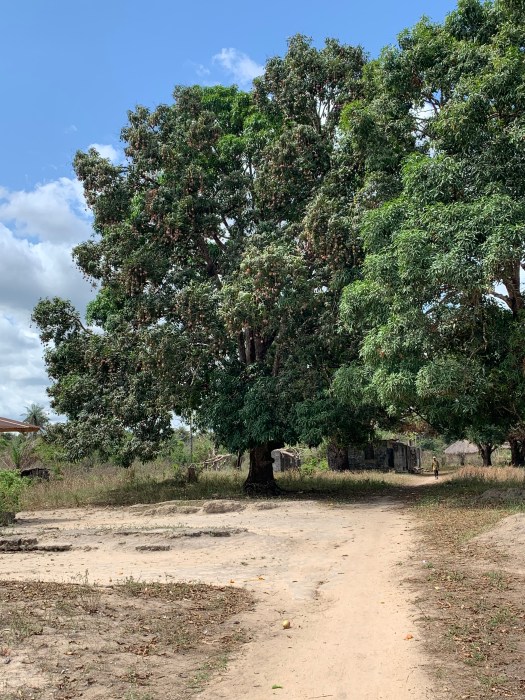
On my way back from Kabala, I bought a good 10 lbs of Shipley mangoes for less than a US dollar. Shipleys are small, yellow and amazing fragrant. I think the one pictured above might be a Guinea mango. I just ate it’s sister. I will eat it tomorrow.
Last weekend, before going to Kabala, I went on a little road trip with a friend who has his own Land Rover. It’s quite bare bones (as in no AC) but managed well enough. When you get out of Freetown, you are almost immediately in another world of small villages and bush. The villages have a few hundred to a few thousand people. The larger ones have a school and a clinic and a small market. There is no electricity but some families may have generators or small solar panels. Most use solar flashlights at night – you see them charging on the porch roof during the day. Water comes from a well or a stream.
It is a level of infrastructure I associate with more remote, less populated areas, but these areas are not remote or unpopulated. The villages are quite close together. You could walk from one to the next and many do. Walking is the main form of transportation. A few have motorbikes. Clearing the land, preparing the fields, planting, weeding are all done by hand.
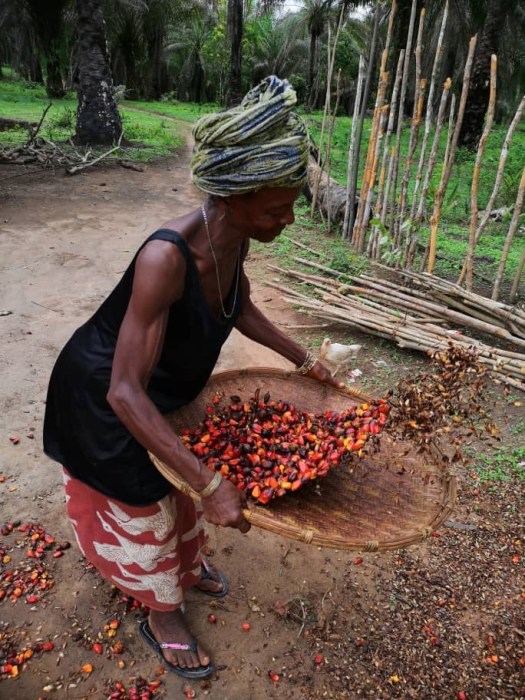
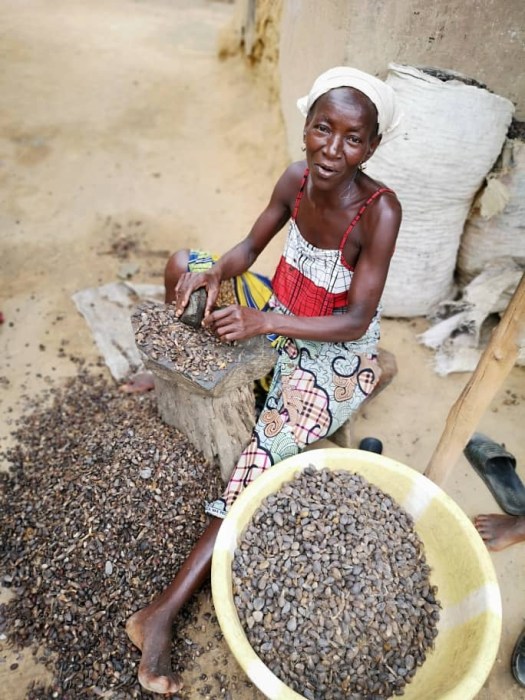
Here are women preparing palm kernels which will be pounded and cooked to make palm oil – a staple for cooking.
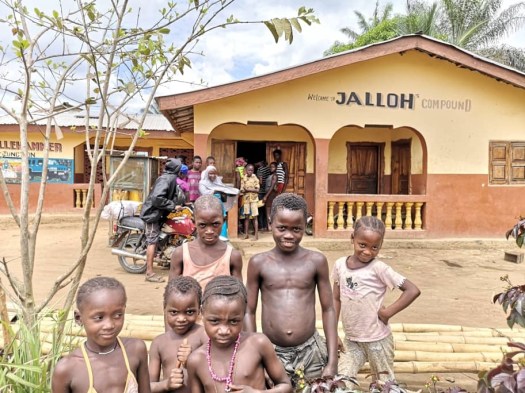
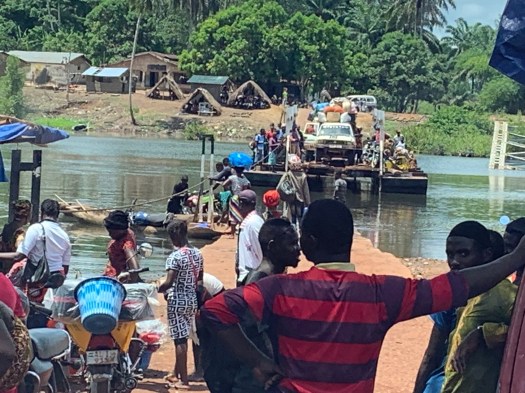
We crossed this ferry on our little adventure. Crew and passengers move the ferry across using the tow line. Note the canoe used to transport a motorbike.
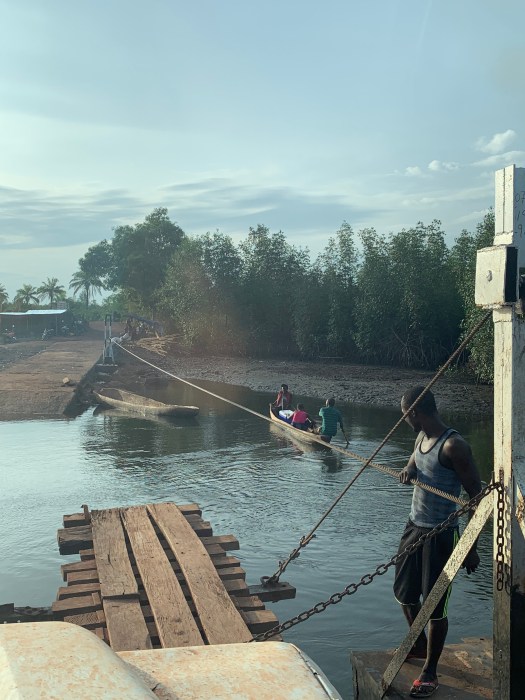
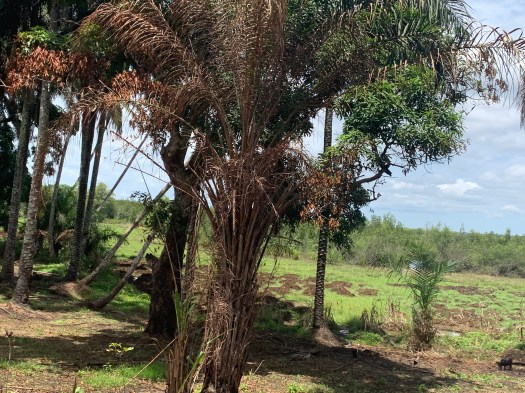
The mounds in the pictures above are how the fields are prepared for planting especially if its lower lying land. Below is how things look when they are further along. Multiple crops are planted together.
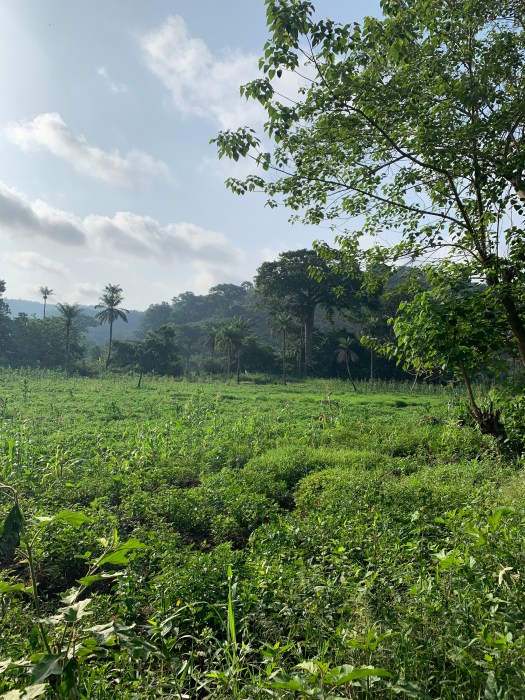
Now that the rains have started, everything is getting green and lush. It is amazing how quickly things grow up where the land has been cleared.
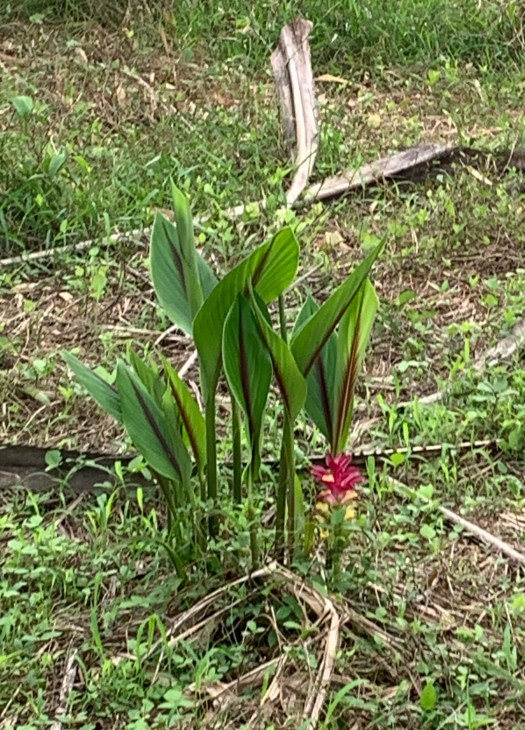
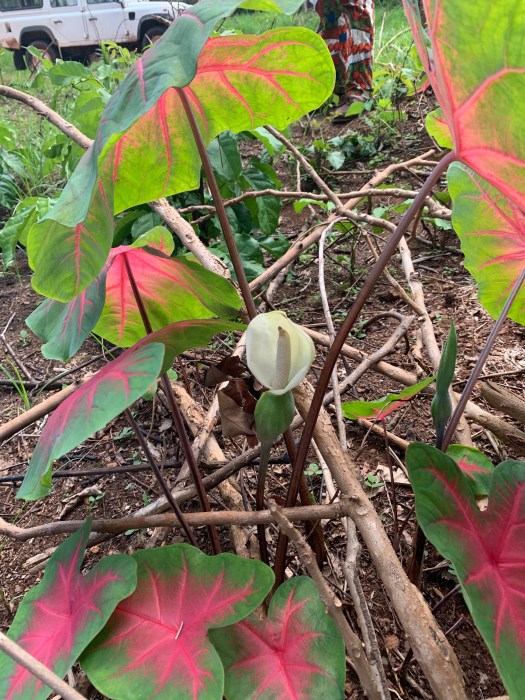
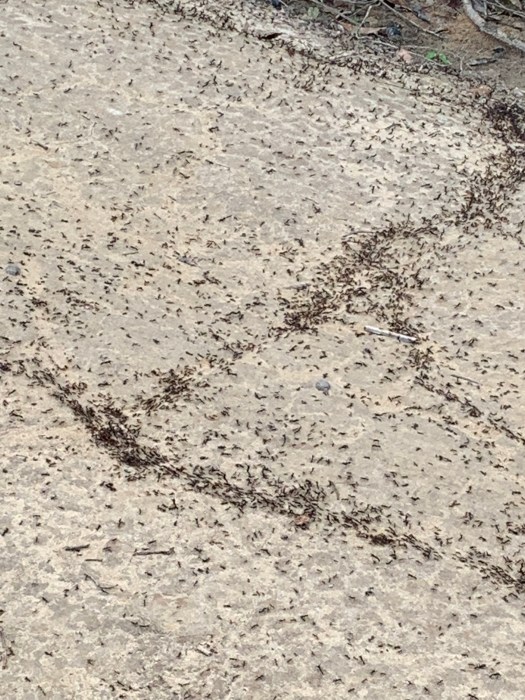
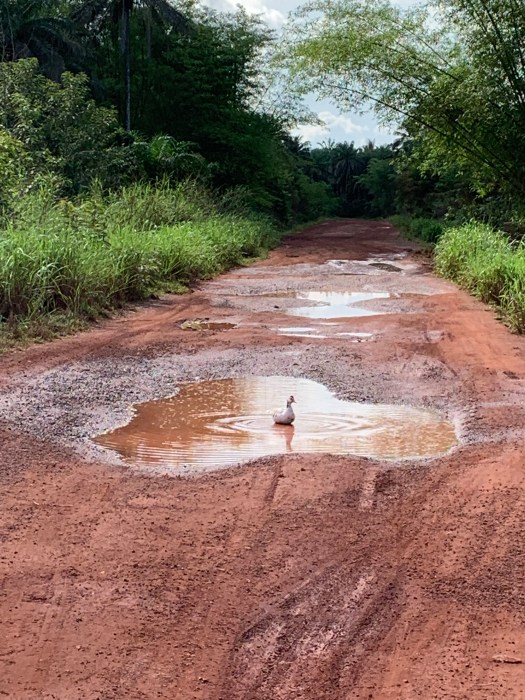
A few other sights from the road trip – army ants in the road and duck swimming in a puddle.
Learning to weave country cloth
Since my experience with Navajo weaving lessons last year was so positive, I looked for opportunities to learn a Sierra Leone craft. It turns out that there is traditional weaver that teaches right around the corner from my hotel.
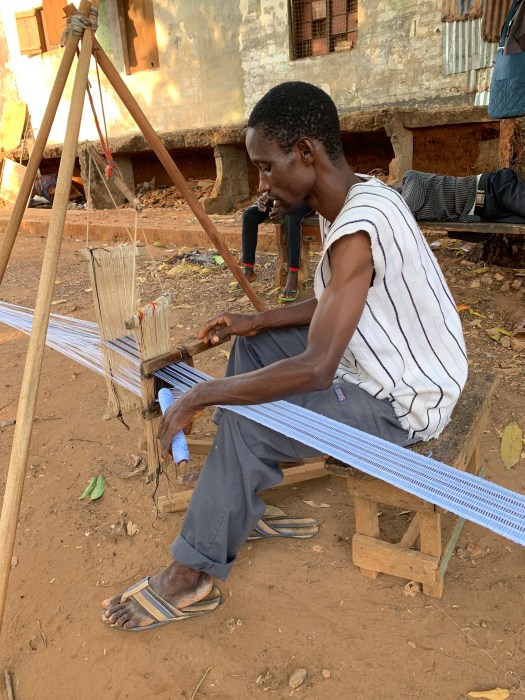
Bangalie learned weaving from his father when he was growing up in Kabala in the northern part of the country. He weaves on the traditional loom but uses different types of thread or yarn depending on what he is planning to make with the cloth. The shirt he is wearing is a traditional style. He also made cloth used to make the flip flops he has on.
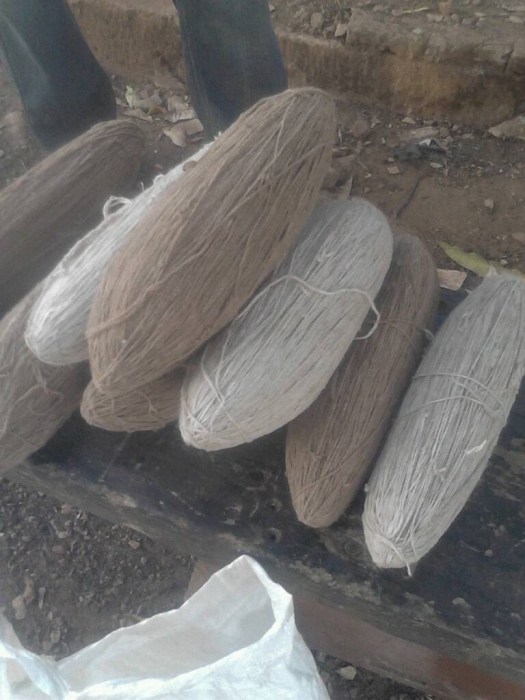
Although weavers now often use purchased yarn or thread, you can still find “country thread” hand spun from local cotton.
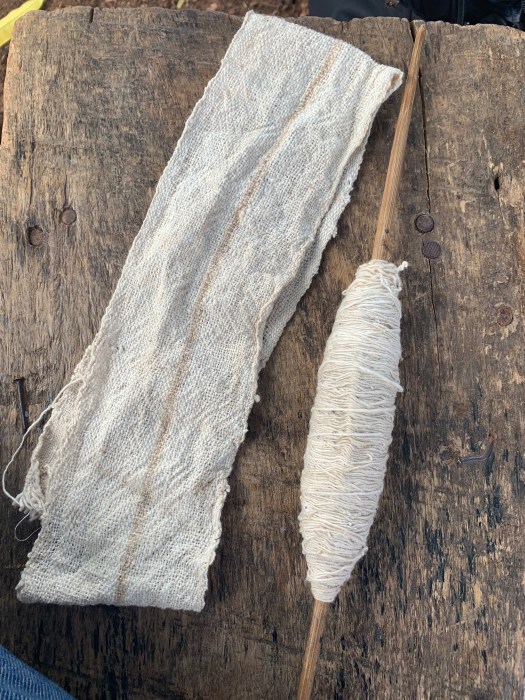
Here is some country thread Bangalie recently obtained from Bo. The darker color is made by smoking the thread – I’m not sure how that works.
Bangalie taught me that the loom is made up of two heddles that look like this:

These heddles pull down alternating threads via the foot pedals so the shuttle can be passed through. The doubled thread of the warp is strung through the heddles and the beater one row at a time.
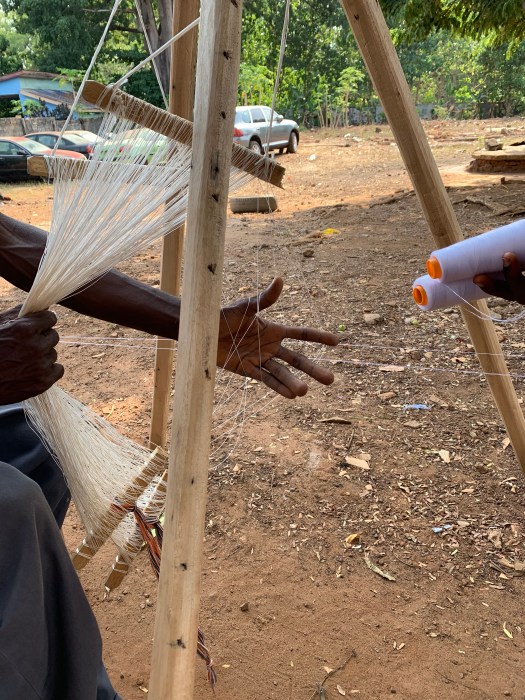

Setting up the loom is time consuming and tedious. Here’s mine once I finished.
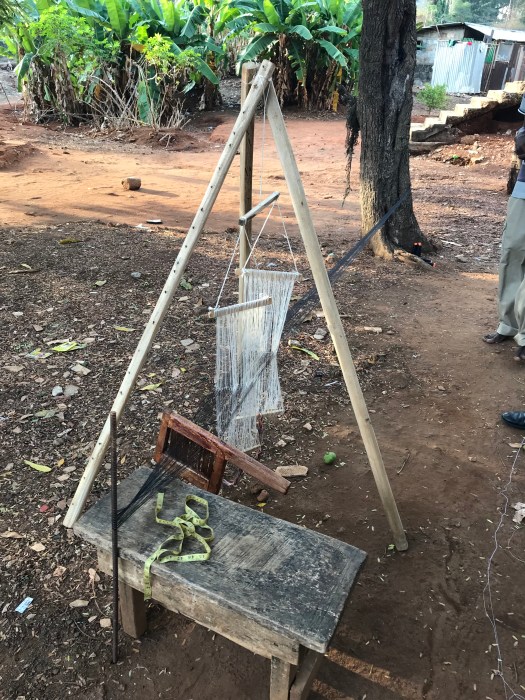
As you look at the next few pictures imagine me weaving with an audience of guys providing ongoing commentary.
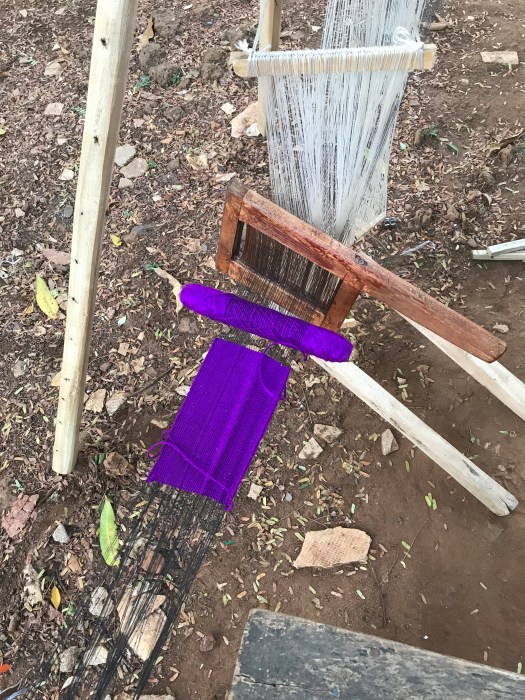
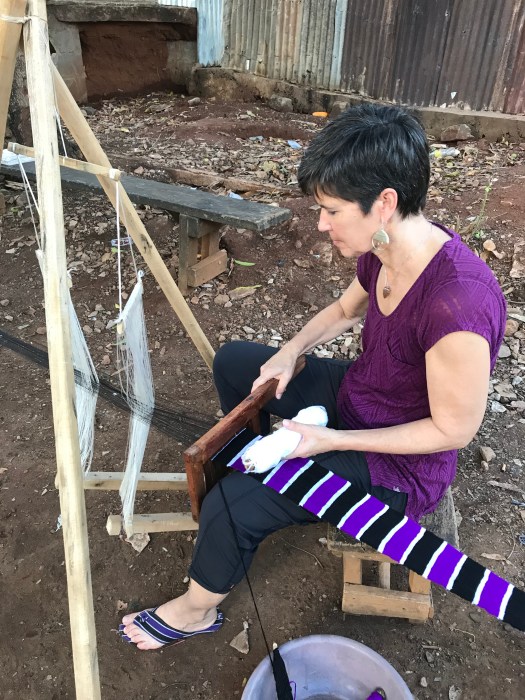
Check out my new “slippers” as flip flops are called here. I got them from Bangalie.
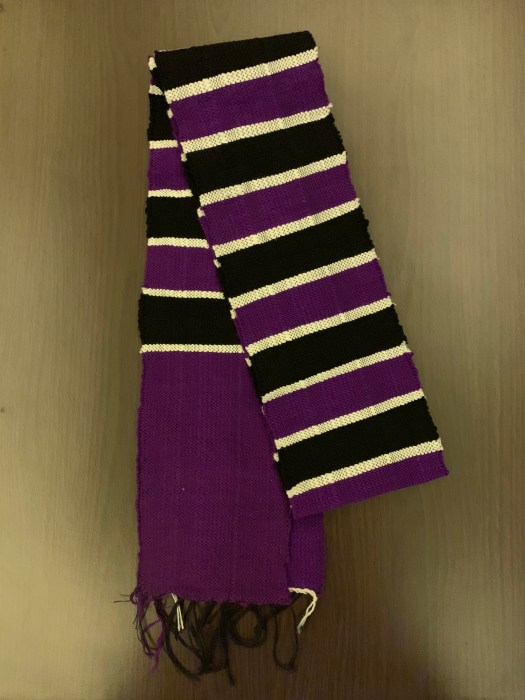
My first finished project!
The rains have started
I’m sitting on the porch of the guest house in Kabala. It is 8:30 in the morning on Cleaning Saturday so I can hear the sounds of sweeping far and wide and smell smoke from trash burning. Until noon on the first Saturday of the month across the country, everyone is mandated to clean. No one is allowed out except to clean the streets. Large trucks will come through later to pick up piles of trash. Of course, as with everything, there are exceptions. We will be able to return to Freetown this morning because our vehicle has diplomatic plates. We are delaying our departure until 10:30 so we can buy produce on the way. It won’t be out for sale until after noon.
I will post this blog later since there is no WiFi here. Actually, there is no electricity except from 7-11pm. There was water from the sink tap and toilet this time since there have been some rains, but no water for the shower. I did get a thermos of hot water to add to the bucket of water this morning so bathing was much more pleasant. Breakfast is a spicy “omelette” with bread.
Since I was here 2 weeks ago, it has become greener. Flowering trees have burst into bloom. And this is just the beginning of the rains. Mosquitoes have multiplied. Ruts and potholes have grown. It will rain more and more each week until the height of the rainy season in July and August. They say that there are fewer mosquitoes in the rainy season because there is no standing water. It was so hot and dry and smoky last time I was here, it was difficult to imagine it could be different. Now I have a glimpse of how things can grow.

On Thursday, I visited another village as part of the investigation. This village was north of Kabala on the “main” road to the Guinea border. Actually the pavement – any pavement ends – in Kabala. Even the road from Makeni to Kabala is narrower and barely paved in spots with car-eating potholes. The village is mainly Fula. Fula are known for trade and cattle-raising. Their villages are notable for small, tidy, round houses with thatched roofs. They are also known to live all over – not in any particular region – and to be relatively wealthier because of the cattle and trade. Fula are often the money changers in Freetown. They are the one ethnic group I can almost recognize because of their small frames and narrow faces.
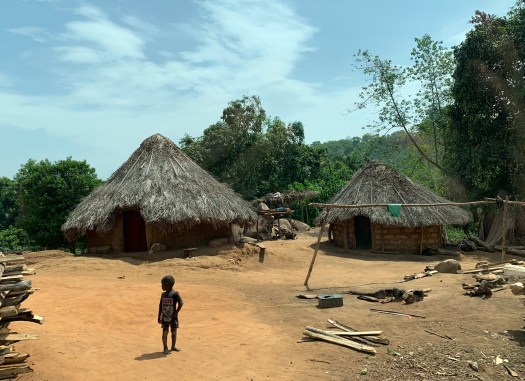
On the drive back, I was entertained by a discussion of common characteristics of ethnic tribal groups. For example, Limba are known for producing and dealing in palm wine (we saw many motor bikes loaded with containers of palm wine on the way into Kabala). Fula are known for drinking it. All this was said with a lot of laughter since it was the Kissi guy saying it when the other guy in the car is Limba. He said Limba are also known for being quiet and living on the edge of towns. Limba wives are the best, according to the two of them, because they are hard working and peaceful. Temne, on the other hand, watch out. They are always fighting. I do not think anyone in the car was Temne. When I asked what people say about Kissi people, the Kissi person in the car said they are known for being fun and liking to be in the middle of things. When pressed for specifics, he said they eat locusts – they consider them medicinal.
The main village where we are conducting the investigation is Limba. As part of the investigation, I learned more details about what people eat in the village. The variety of cultivated and wild foods is really astonishing. Keeping everyone well fed throughout the year can still be challenging. The village is supplementing its diet with bush meat (yes, this includes monkeys) and foraged foods like bush yam, locusts, and black tambla. They buy some imported rice since they are now using the hillsides to plant spicy peppers instead of upland rice. Peppers can be sold for cash and was the source the income used to build some of the newer houses I saw.
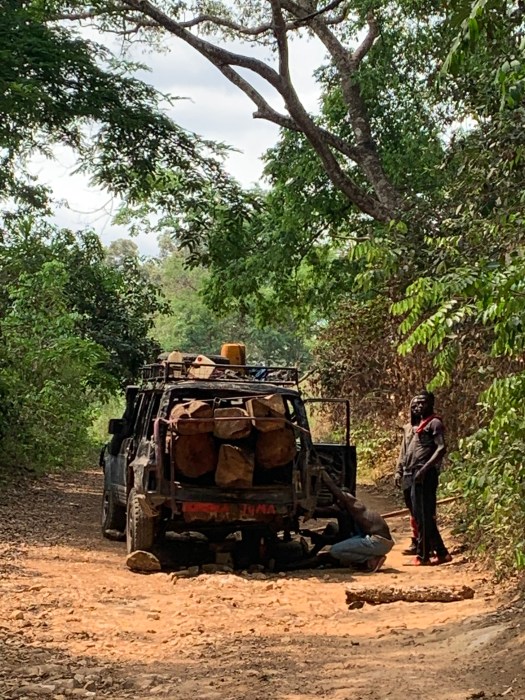
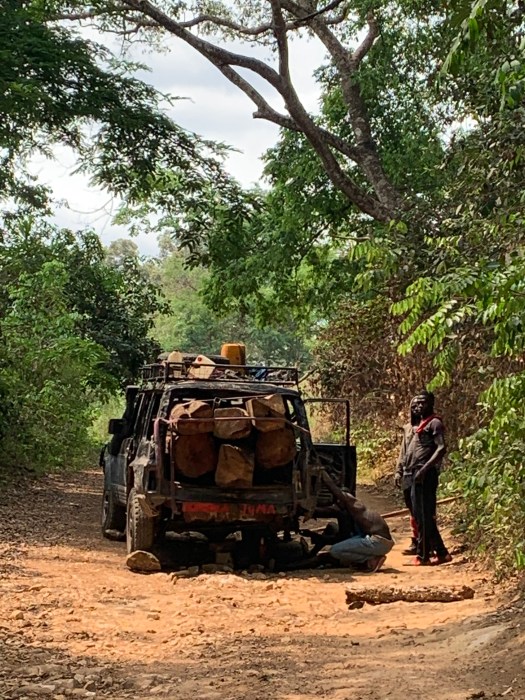
The other source of income was timber. While we were there, we were surprised to see a SUV zoom through the village. We have been parking at the bottom of a supposedly impassable hill. It was a timber truck going through to collect logs. Later I heard the driver was smoking with one hand and swigging rum with the other. These guys really live on the edge. Below is a previous picture of a typical timber truck – doors and windows removed.
On the way back to Freetown, we shopped for produce – cheaper and fresher than what you can buy in town. When you stop by mango vendors, there is a mad rush to your car. These taxis and buses will go back to Freetown loaded down with mangoes.
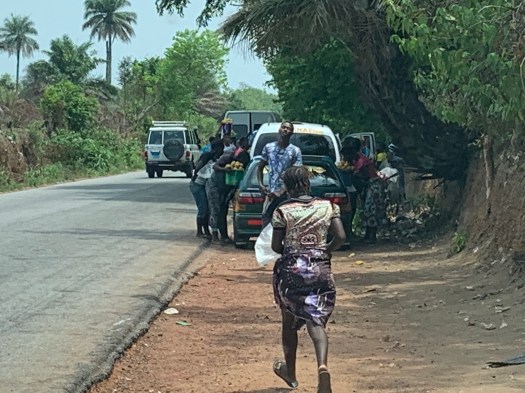
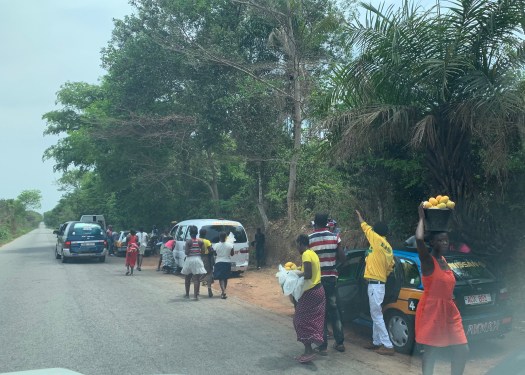
We also bought yams, cucumber, pineapple, plantains, and avocados.
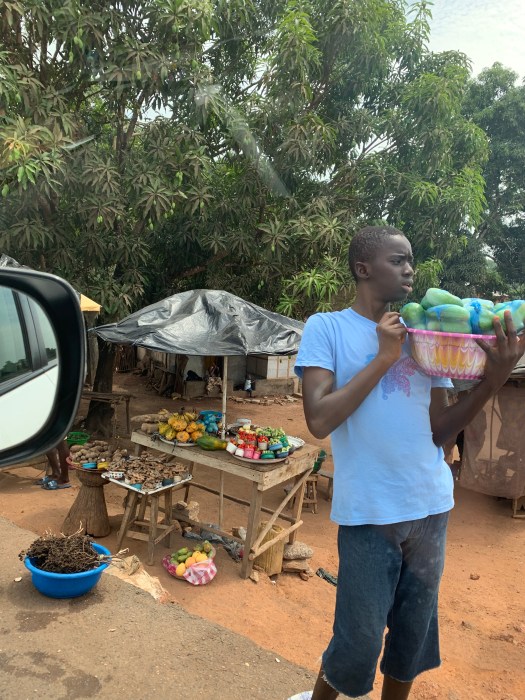
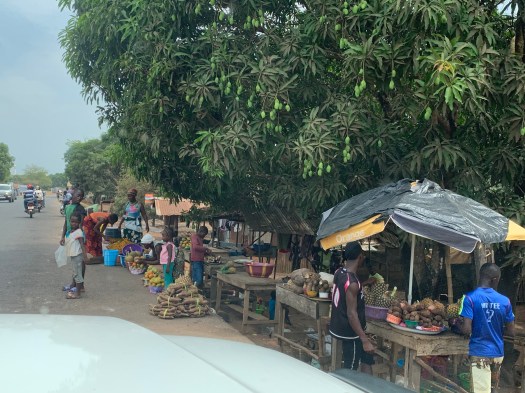
Sadly, delaying our trip to buy produce brought us into Freetown in time to get stuck in road construction traffic for 2.5 hours. Was it worth it? Now that I’m eating mangoes and pineapple everyday, I’d say yes.
The biggest hike yet
Last Saturday, I joined a group hiking from the east side of the peninsula to the west on an old trail used for at least 200 years and possibly longer. The trail starts in the village of Koba, just past Waterloo – the town where the peninsula connects the mainland. It crosses the mountains and ends at Big Wata (a river) near York, one of the early settlements on the west coast of the peninsula.
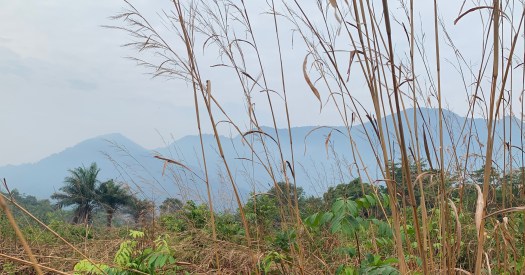

If we had hiked straight across the trail might have been 7.5km, but we hiked partway and turned south to hike up to the highest peak on the peninsula – see the photo below.
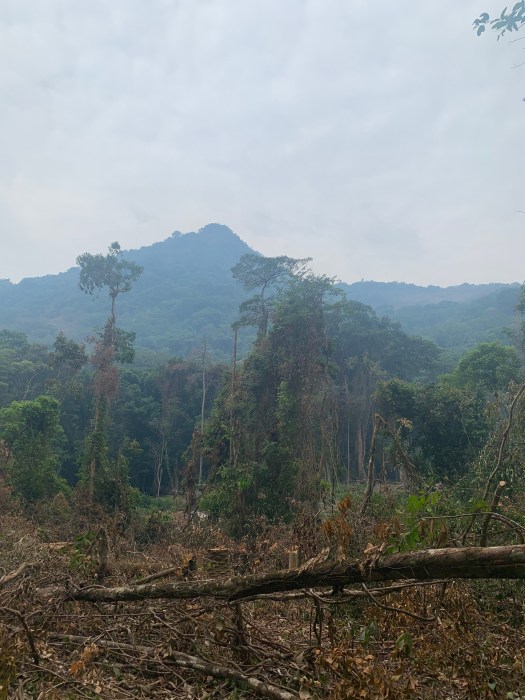

Although there was some burning to clear for planting, there were still some large trees and dense forest. Fortunately, it was a cloudy day so not as hot as it could have been.
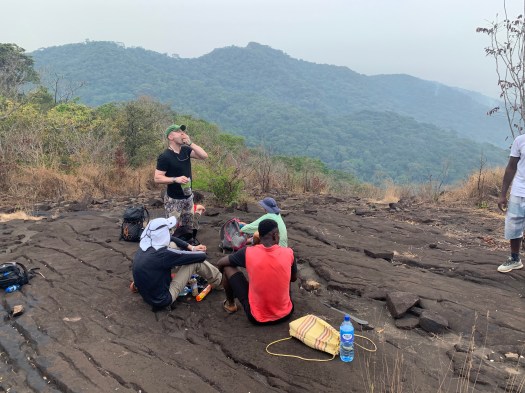
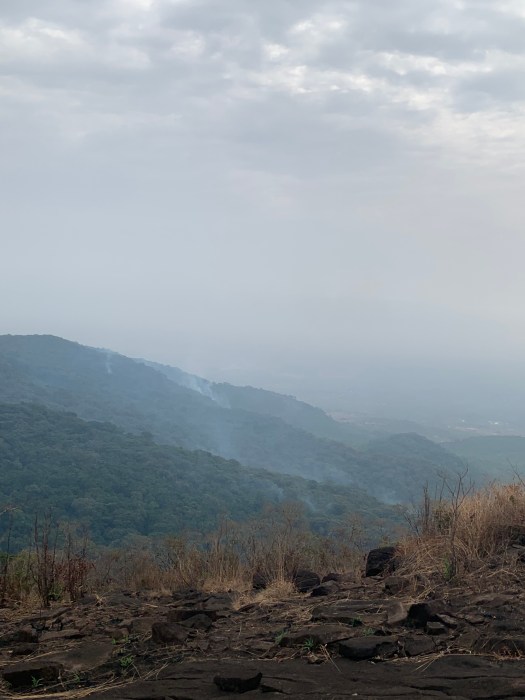
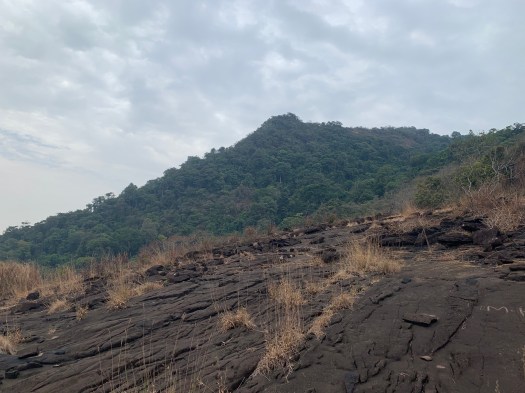
We took a short break in an open area. Above the peak is getting closer but there is still almost an hour of uphill climbing. Note the local guide below in flip flops. When it got really steep, he took them off and went barefoot.

We had lunch at the top after about 3 hours of hiking.
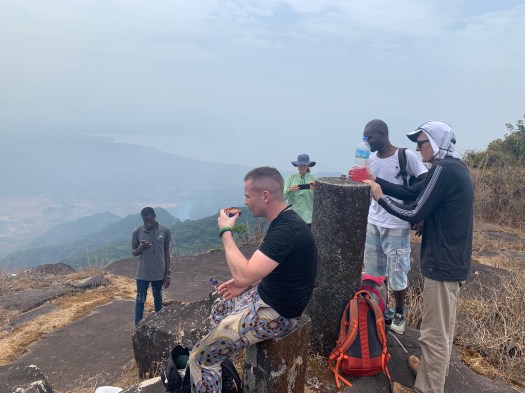
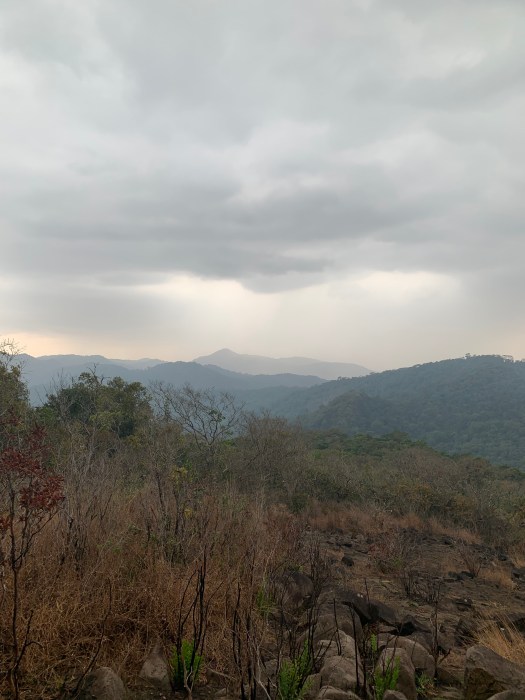
On the way down it actually started raining which was nice and cool but made the downhill treacherous with a choice between placing feet on slippery rocks or slippery leaves. We all made it safely to the destination and had logged 9.8 miles!
Local crafts
While in the north, I had a chance to visit some local craftspeople and see them working. In Kabala, I visited a housing area established for wounded survivors of the civil war. I two weavers of country cloth. The first, a woman, lost her whole village. She survived by crawling under dead bodies as everyone was shot. She was shot through the chest but survived and somehow crawled and walked until she could get help.
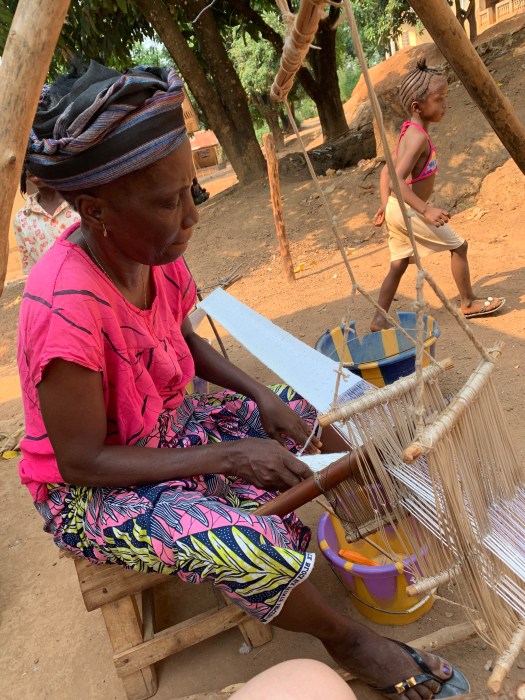
Country cloth is traditionally of cotton woven in narrow strips and sewn together into clothing or blankets. She uses her foot to work 2 pedals to alternate in pulling down the heddles. I just started weaving lessons today so am practicing the terminology.
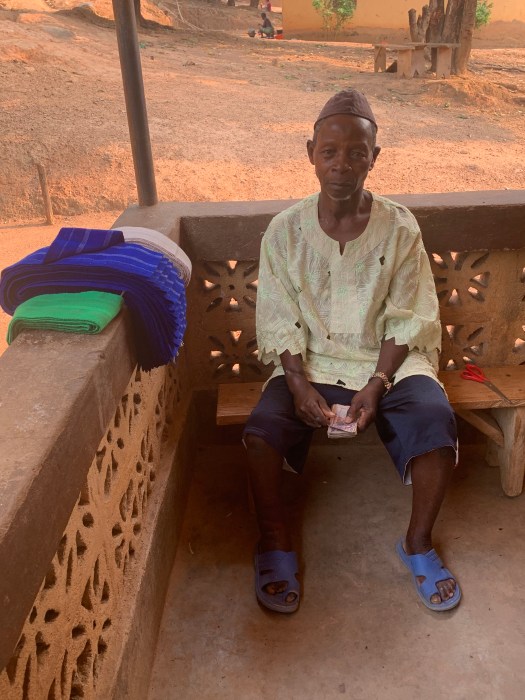
The second weaver was hacked with a panga (machete) and has permanent damage to his right arm and right foot. He is unable to move the fingers on his right hand despite multiple operations. His cloth is laying on the wall next to him. He’s holding money because I just bought some of his cloth. He looks sad because he is. He says it is hard to not be able to take care of his family.
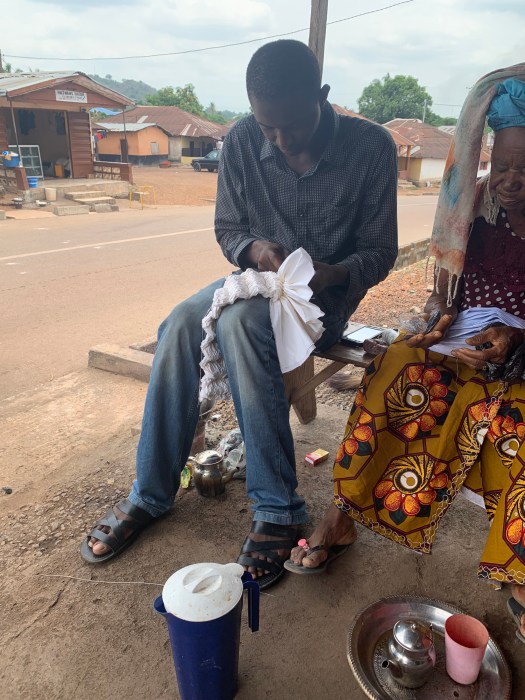
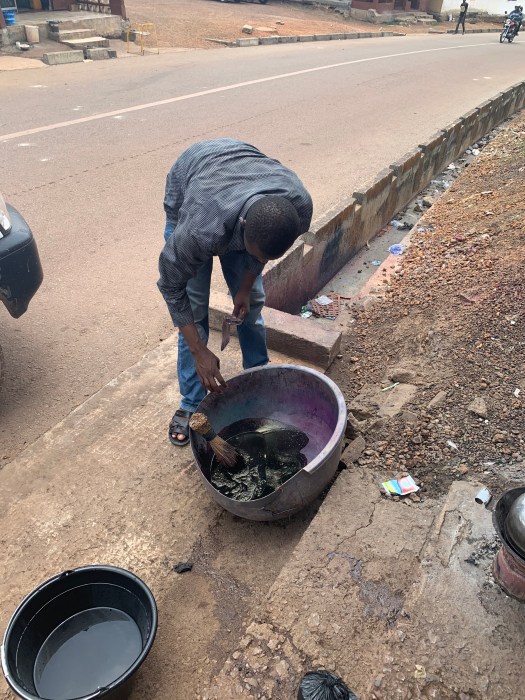
Makeni is known for gara cloth which is tie-dyed. Most of the people that make gara cloth are Mandingo. The traditional dye used is made from kola nuts but most people use commercial dyes. First he sewed the cloth together, then dyed it. It smelled awful. When it first came out it was greenish and then turned maroon in the sun.
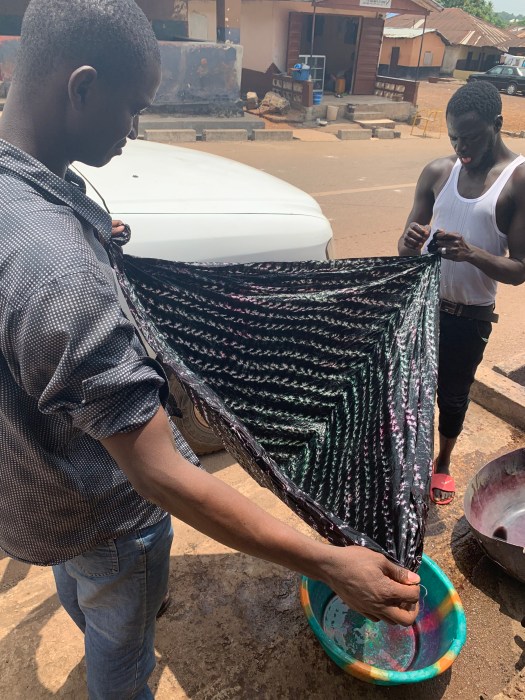
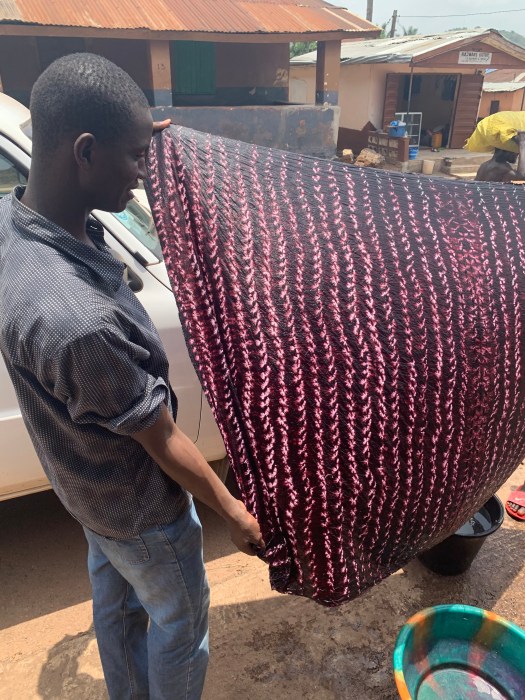
After it had dried in the sun, we went to get it waxed. This makes it shiny and better according to everyone. We walked a short way up the road behind a house to a shed where we could hear rhythmic beating noises. Inside two guys were beating cloth with large mallets in such harmony they moved like one person. First they sprinkled the cloth with a bit of water and let it sit. Then they rubbed some candle wax on it and on the wooden mallets. Then they would beat it all over, refold, and beat some more until the wax was fully distributed and the cloth smooth and shiny in a tidy folded bundle.
All the while they are moving the cloth and keeping the rhythm without ever smashing each other’s fingers. The rhythm had a regular hitch in it when they switched the mallet from one hand to another. And they were sweating like crazy – just pouring of of them. It was stifling hot in the little shed. They were listening to the radio, beating cloth, pausing briefly to wipe off sweat and drink water, and then would continue beating cloth. Look at the size of the mallets! I have to say that they appeared to be extremely fit.
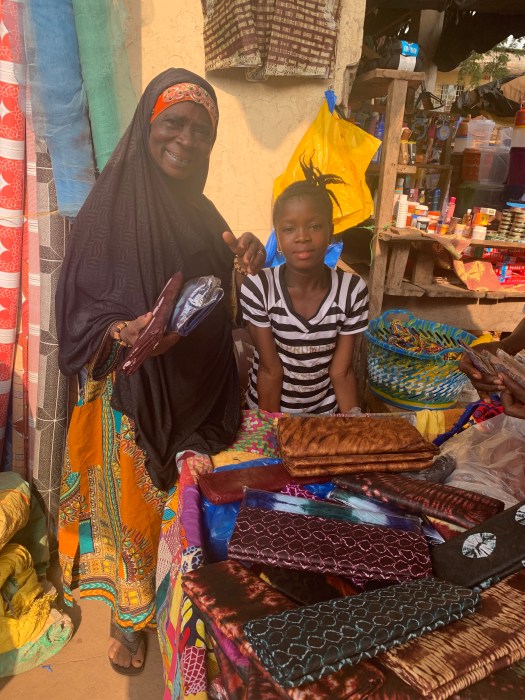
I bought some more gara cloth at the market including some with the traditional kola nut dye. It’s the chestnut brown cloth on top.
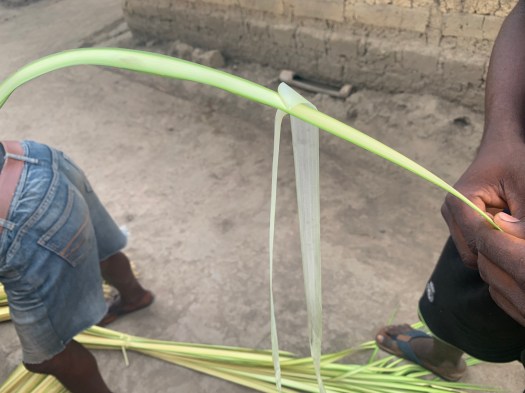
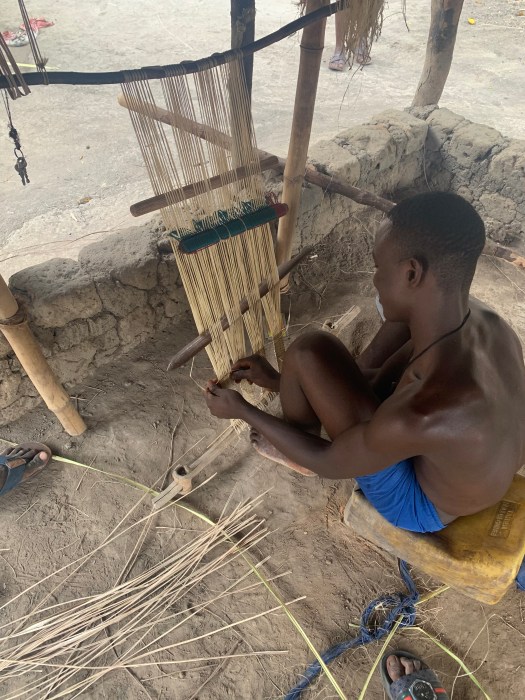
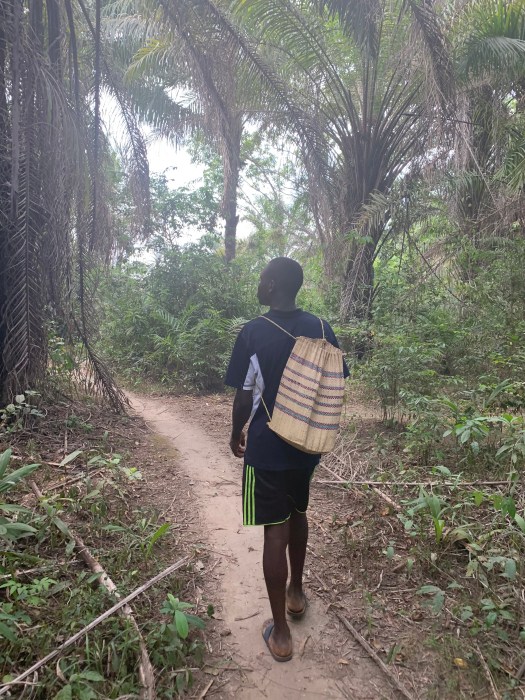
In Rogbonko, they specialize in basket weaving. They use part of the palm frond. It is woven on looms like cloth and made into bags. There is another style of basket making for bowls and round containers that be used to store or to attach a strap and carry like a purse.
Local crops
While in Kabala I had an opportunity to visit a village, Senikadugu, that raises vegetables to export to Freetown in addition to growing to feed themselves. Because the village is on the main road heading north to Guinea it was heavily impacted by Ebola and as a consequence had been the recipient of significant aid from international donors. Attention-getting tragedy does often seem to be followed by donor aid. The agricultural support, the village well and the primary school and village clinic buildings were all the result of international aid.
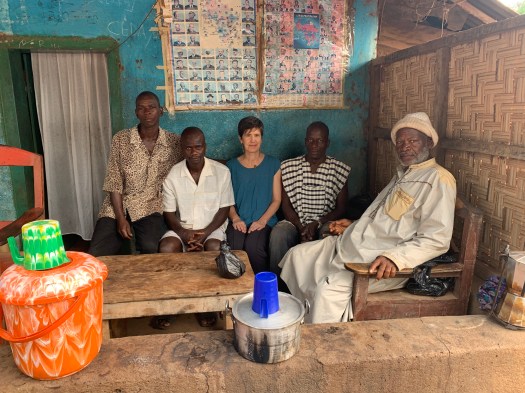
Below is the obligatory picture of me with the chief (to the right of me in the special traditional country cloth shirt) and other village leaders after the presentation of the kola nuts and my adoption into the village (that part is not usual). I think I was adopted to either encourage me to donate to the village or come back and see children at the PHU – both were suggested.
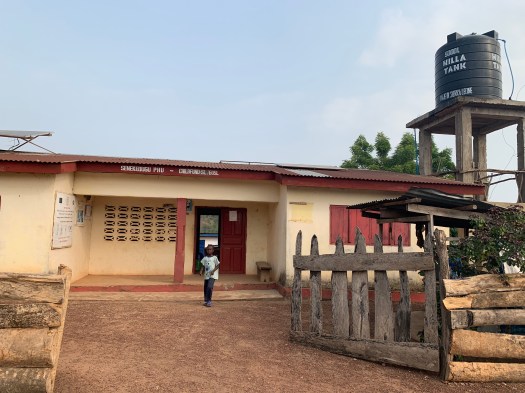
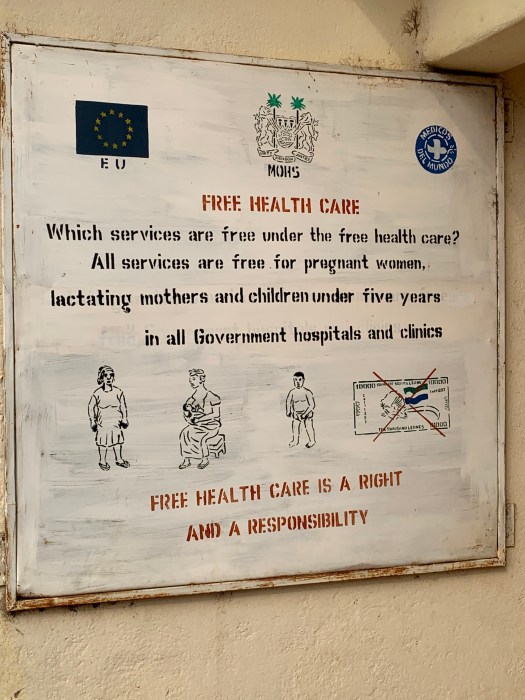
I was able to visit the clinic called primary health unit here, or PHU’s. These are the smallest unit of the primary health care system. Health care for pregnant women and children under five years is free and primarily what is provided at the PHU. It is limited to prenatal and well baby care, immunizations, and very basic acute care.
I was also taken on a tour of the fields in the lowland near the river and left with gifts of lettuce, tomatoes and cucumbers straight from the fields. They also grow groundnuts (peanuts), cabbage, okra, zucchini, beans, chili peppers, cassava, potatoes, and eggplant. Note how the planting on mounds of earth. All this is done by hand. Tractors are rare. In most places, the area is burned, the brush cleared, and the soil prepared by mounding it into hills or beds. Then it is planted as the rainy season approaches.
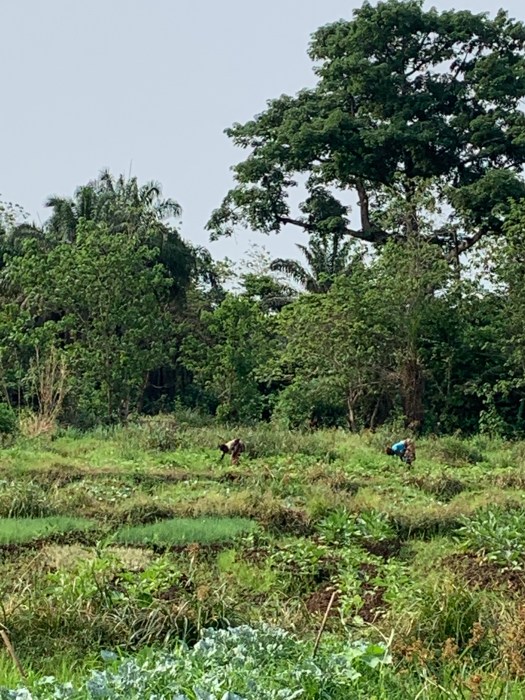

In Rogbonko, a teenager named Mohamed gave me a tour of the fields and orchards. They grow such a wide variety of crops – many of the same vegetables as Senikadugu, but also have cashew, kola nuts, coffee, papaya, mango, banana, jackfruit, coconut, palm nuts and avocado growing on trees.

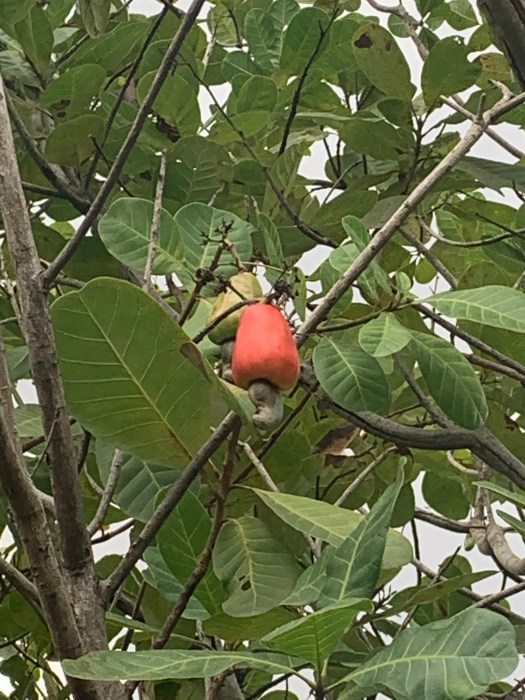
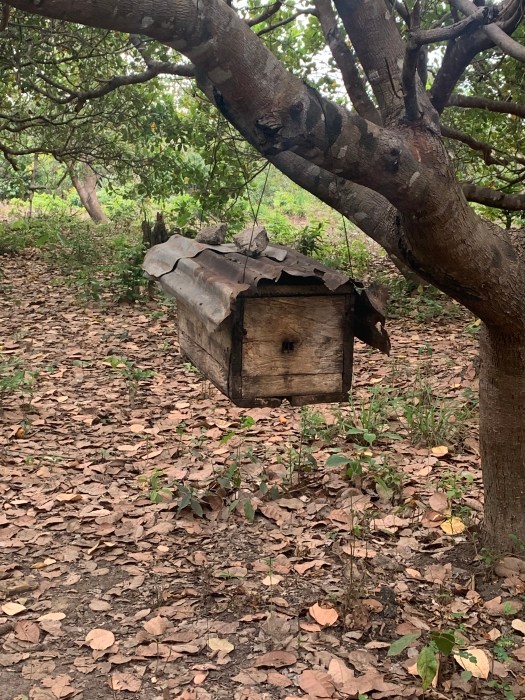
Above are cashews – unripe and ripe. The fruit can be delicious and juicy. Note the beehives hanging in the cashew orchard.
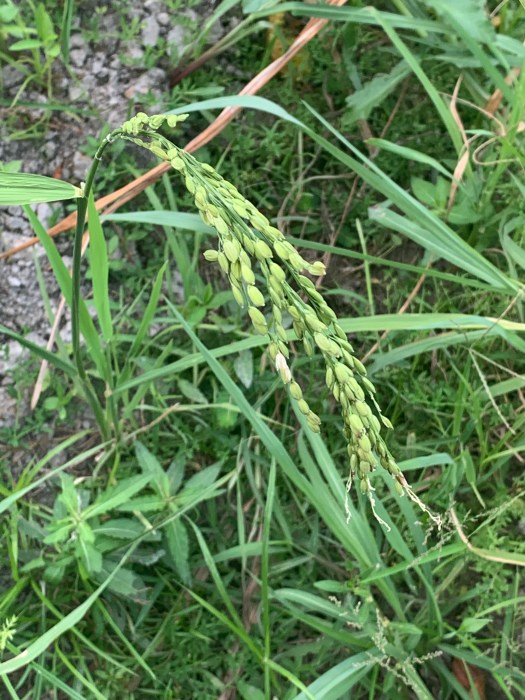
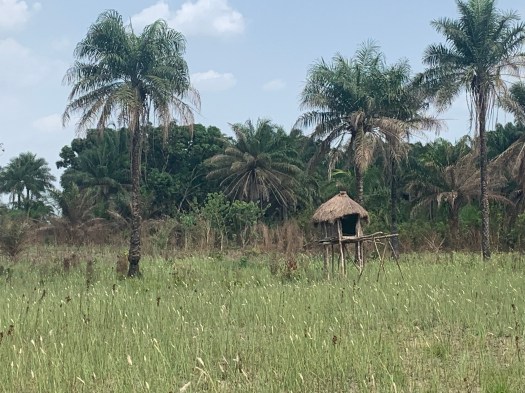
Above is rice and the hut where someone has to hang out all day to chase away the birds.

And pineapples between the palm trees. When we first started our walk, I thought the village was surrounded by forest. I realized, as we went along, that most of it was cultivated to grow something edible. Many things were planted mixed together in such a natural way that I had completely missed them.
Below are some pictures of palm nuts being processed into oil.
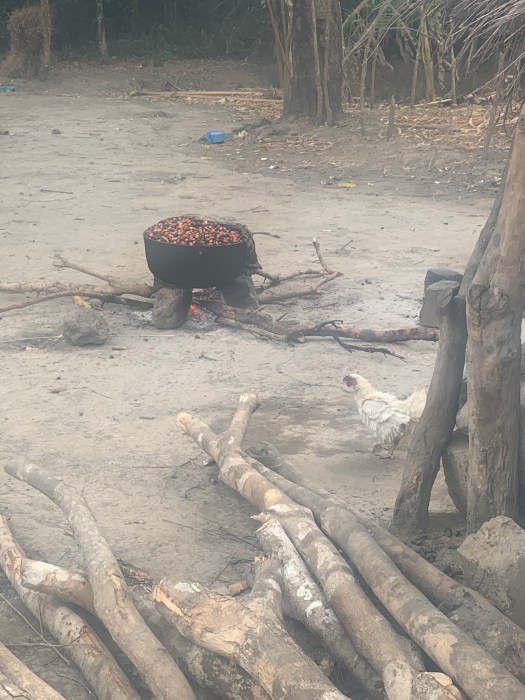
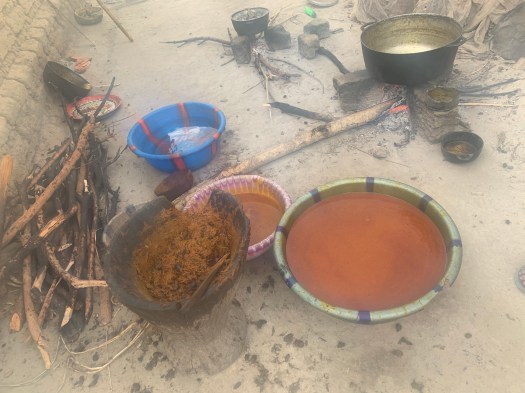
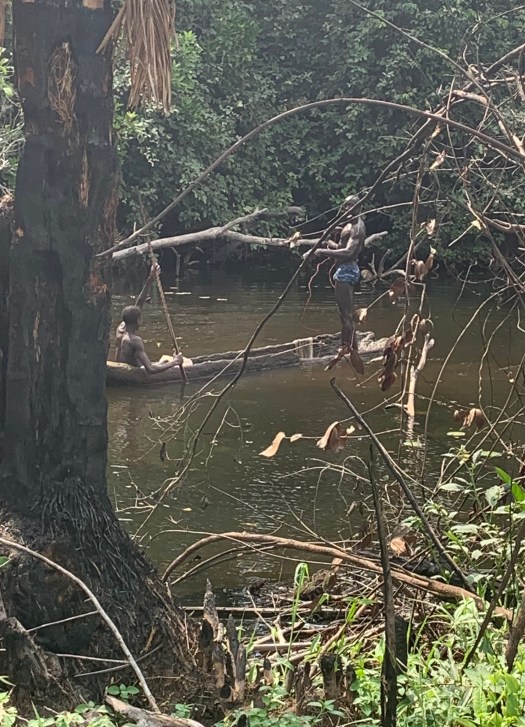
Villagers also fish in the river that runs close to the village and smoke the fish to keep them longer.
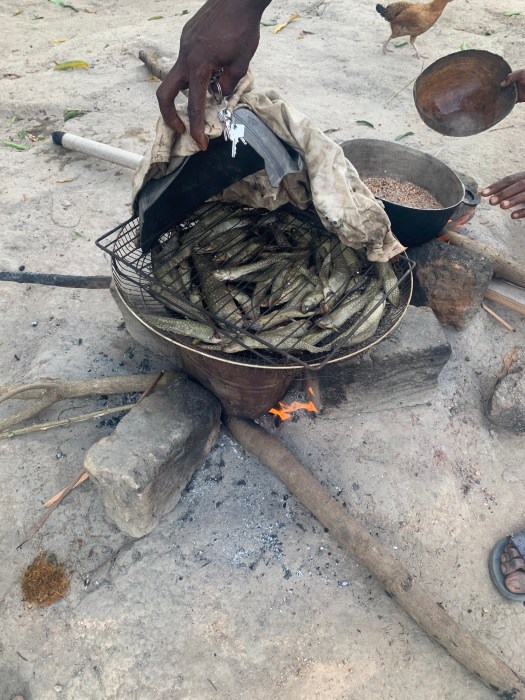
Rogbonko village, like most villages, keeps goats and sheep as well as chickens and ducks. The chicks are dyed pink and green to keep hawks from eating them. They swear it works.
Large mango trees are everywhere in Sierra Leone and the season has started. They are for sale along all the roadsides and everyone you see seems to be eating one. People often eat it skin and all leaving only the pit which is left lying on the ground.
Climbing hills and other scenic sites (continued)
Other Scenic Sites
We also visited Lake Sonfon and Bumbuno Falls – both sites with cultural and spiritual significance. The visible lake of Lake Sonfon is quite small – especially since it is the end of the dry season – but grows large during the rainy season.
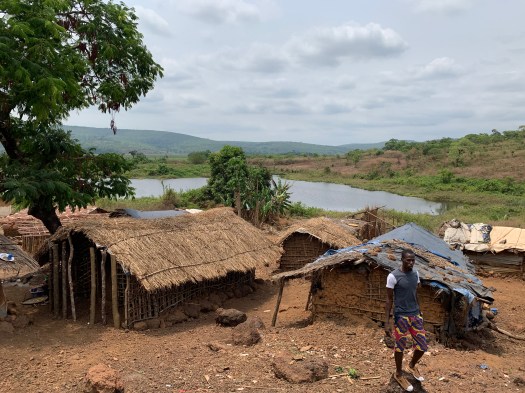
It is surrounded by a vast stretch of green. During the rainy season the water level rises quite a bit.
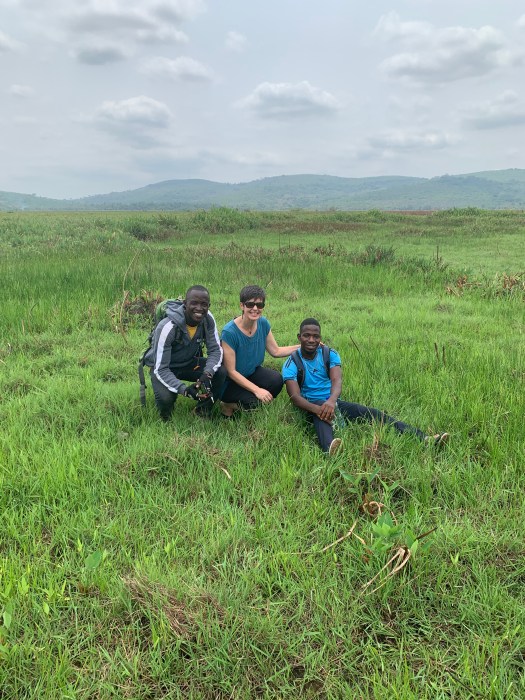
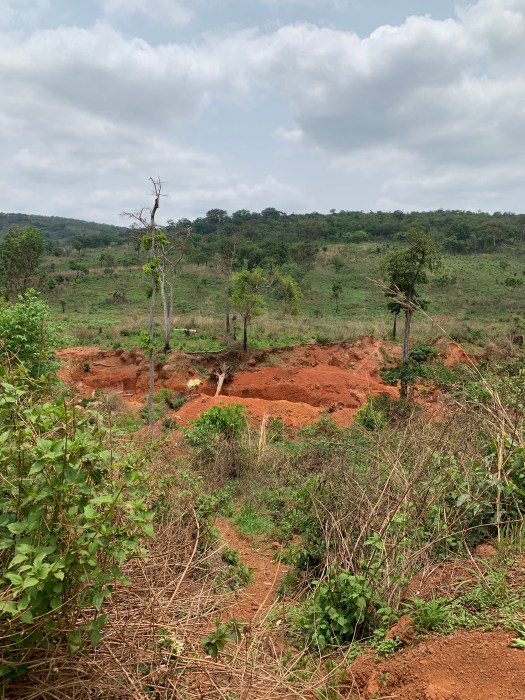
The area is supposed to be protected from hunting, farming and mining leaving no legal livelihood for the very impoverished village on the shore of the lake. I saw evidence of farming and mining – there is gold in the area.
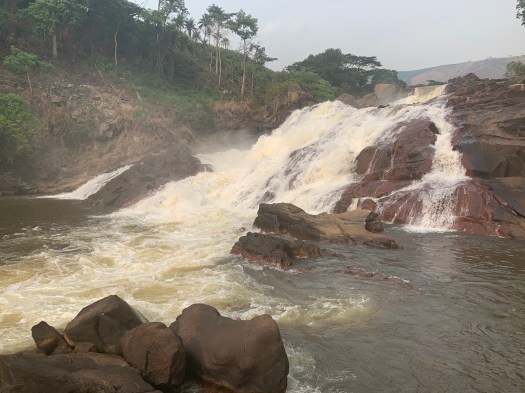
They say that in the rainy season the water over the falls is even more impressive.
To visit most of these sites, the guide arranged with a local guide to let the community know I was coming. I would first be taken to see the chief and present a small gift of money and kola nuts. Kola nuts are the traditional gift to the family when proposing marriage but also used in general as a gift of respect.
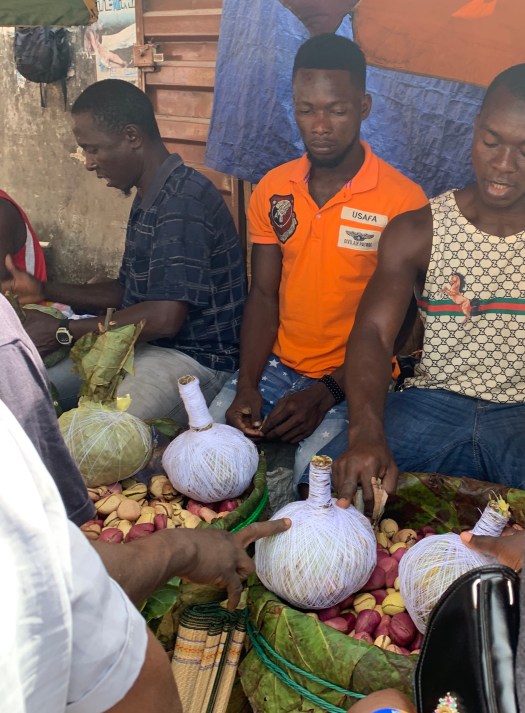
My kola nut bundles were smaller and wrapped in less thread. The pink and white are the sweet and bitter kola. They are both pretty bitter and contain caffeine.
To reach Lake Sonfon and Bumbuna Falls, we drove for hours over very rough roads with homemade bridges past many villages. Here the guides check out a bridge before we attempt it in the car.
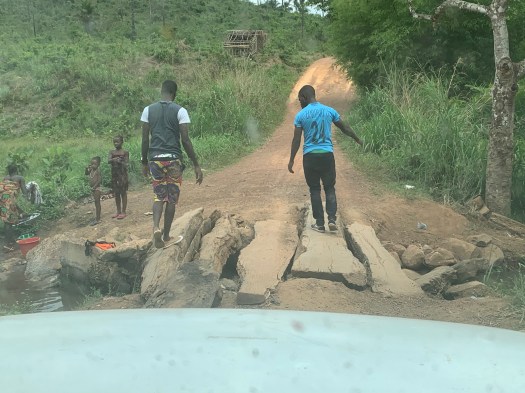
None of the villages have running water or electricity. There were a few solar panels and generators. Some villages have wells but many do not. Some have schools or small clinics but others have to walk for miles for those services. Villages with wells, schools or clinics often have them because of a donor so long term support or the ability to make repairs are lacking.
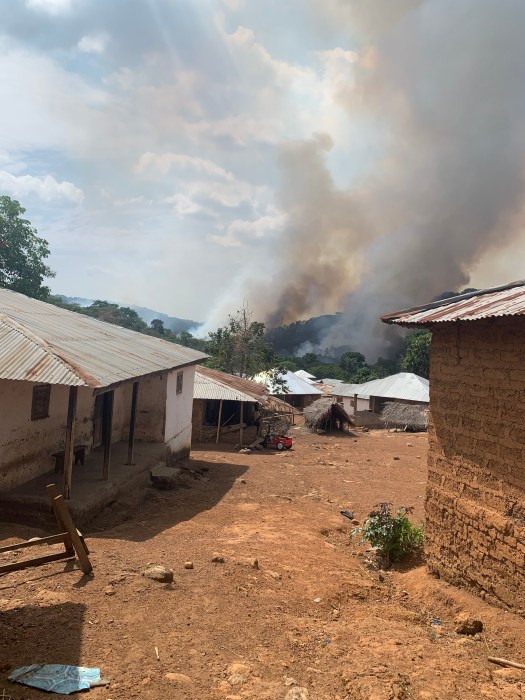
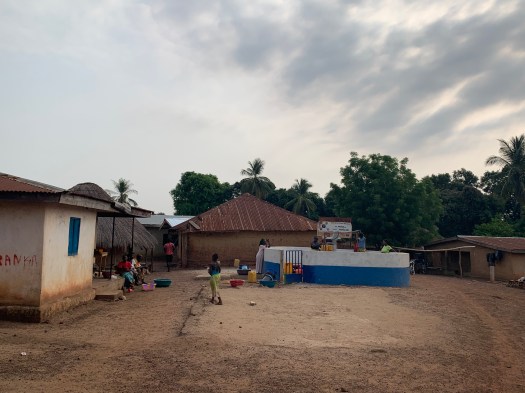


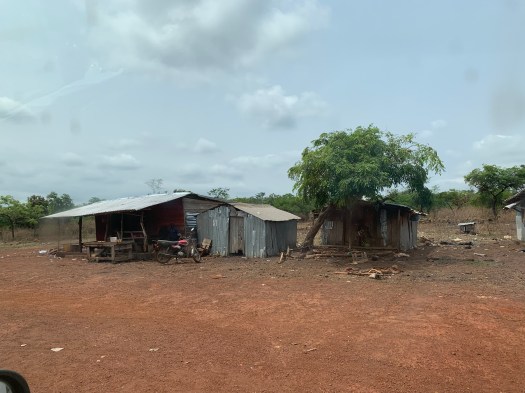
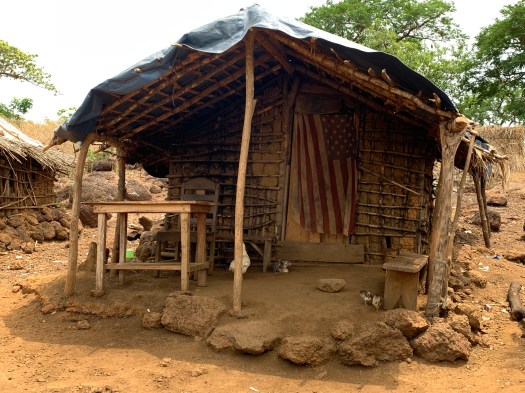
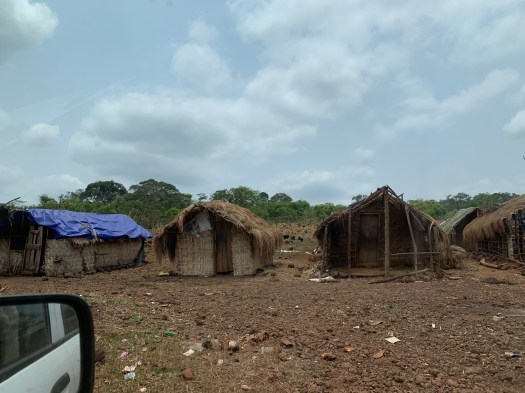
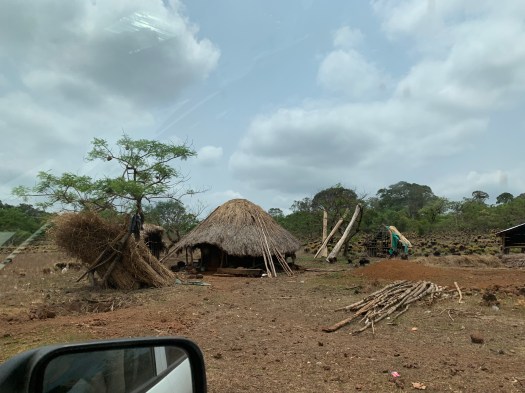
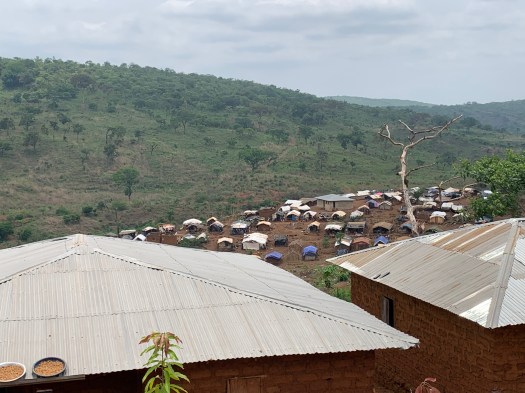
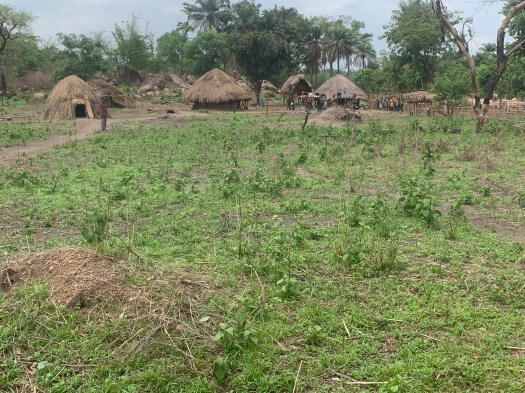
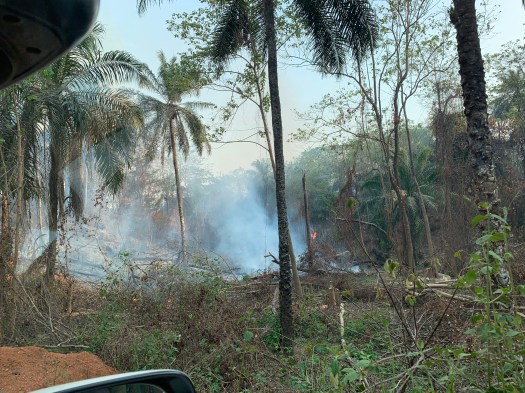
Land was burning everywhere to prepare for planting before the rainy season. We saw piles of timber from illegal logging and illegal gold mining. The exploitation of natural resources that has taken place for centuries has benefited few here. Communities have limited options to support themselves and few are environmentally sustainable. Still it is difficult to witness such blatant destruction.
Climbing hills and other scenic sights
Since I was going to be in the north for work the week before Easter, I planned to do some sightseeing in the region over the holiday weekend. It was a little complicated because (1) I could not find anyone to go with me and (2) I needed to hire a rental car and driver and a guide to meet me in Kabala after the embassy car and my co-worker returned to Freetown. Conveniently, my office mate works in tourism on the side so helped with the planning and arranged for a guide. People at work also helped reserve hotels and the rental car. As I write this I realize that it was not that complicated since I had a lot of help. I just had to get over the cost of the car and driver and the idea of spending some days with 2 guys I did not know. Turns out I spent time with 3 guys I did not know and it was fine. I’ll share some of the highlights.
Climbing Hills
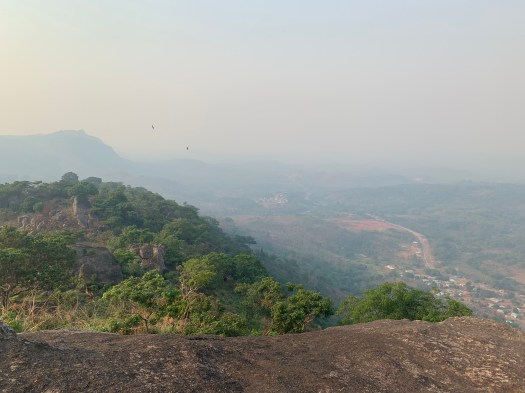
My guide for the trip was Andrew Fortune Bassie. While in Kabala and the Koinadugu District, he arranged for Moses as the local guide. Moses took us to the top of a hill in the Wara Wara Mountins overlooking Kabala (seen below).
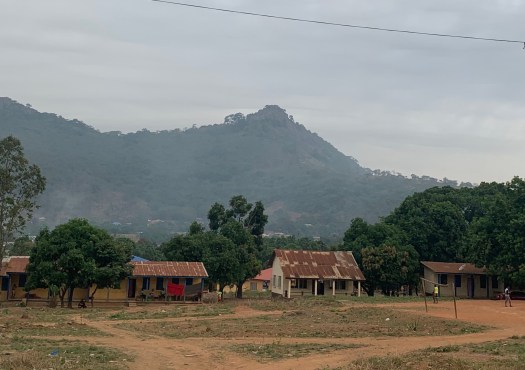
In the view below looking north you can see the village of Senikadugu where I was adopted – more on that later.
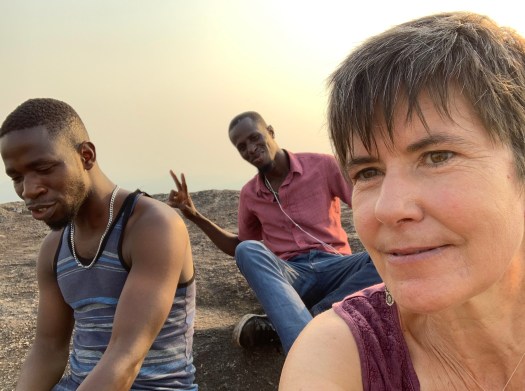
Moses is on the left and Andrew in the middle.

Later in the trip, Andrew and I climbed two important hills overlooking Makeni. Both are sacred sights and must be approached with care. Strange things can happen there I was told. We climbed the male hill – Wusum – in the morning. It was very steep and had burned grass stubble all over it.

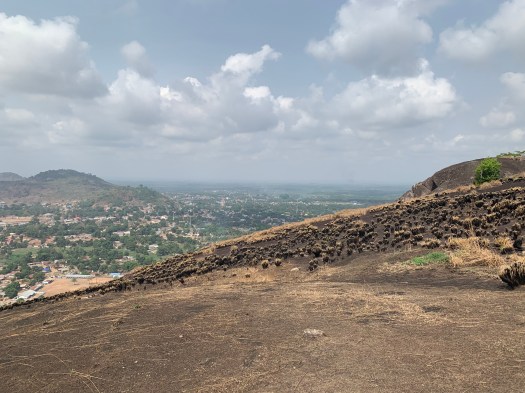
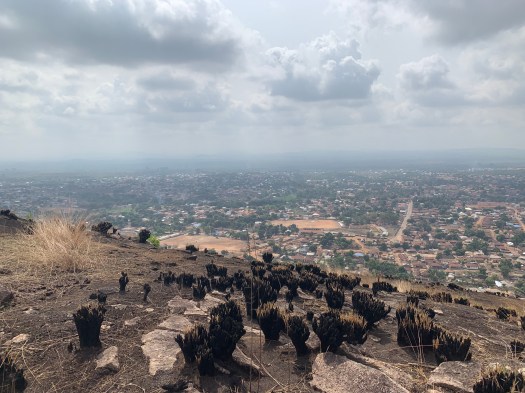
In the late afternoon, we climbed the female Mena Hill – a very special place.
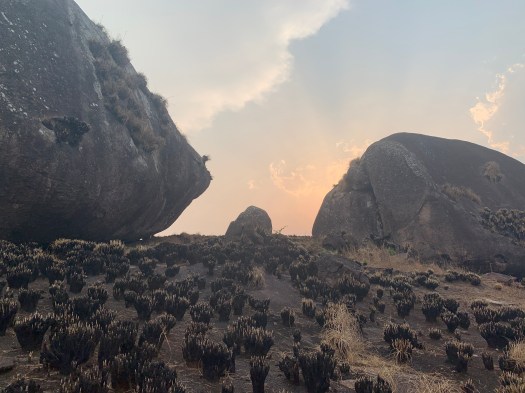
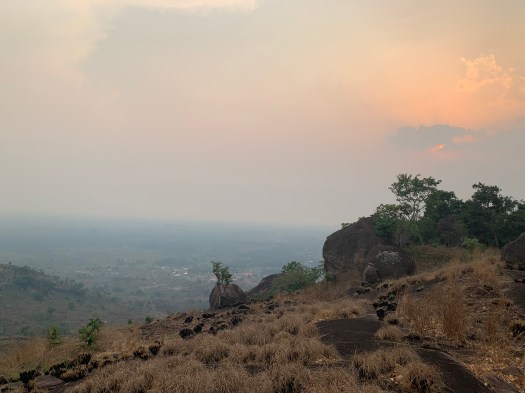
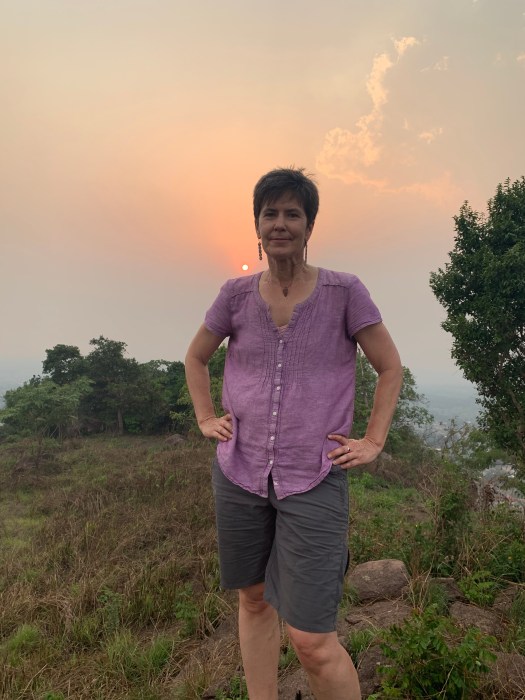
The light was amazing at that time of day. The panoramic pictures were wonderful but I cannot get them to upload here.
All of the hills I climbed are spiritually significant sites where the community gathers on special days to make offerings and prayers (all faiths) and then play music and dance all night.
Leaving Freetown and heading north
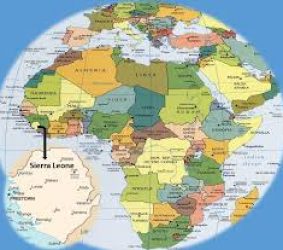
Remember that geographically Sierra Leone is about the same size as the Navajo Nation but has 7 million people instead of 200,000. Although a good chuck of the 7 million live in Freetown, there are still lot of people living in district towns and the many villages. Unfortunately, the road situation is similar to Navajo so that there are paved roads to the few bigger district capitals and everything else is dirt.
I left Freetown last Monday for Kabala, 189 miles away. This is, incidentally, similar to the distance between Chinle and Flagstaff. The road is paved the whole way and even starts as a 4 lane toll road thanks to the Chinese. But it fairly quickly goes to 2 lanes and after Makeni has frequent treacherous potholes.
Traveling up country is not undertaken casually. I was advised to take a supply of water and extra food.

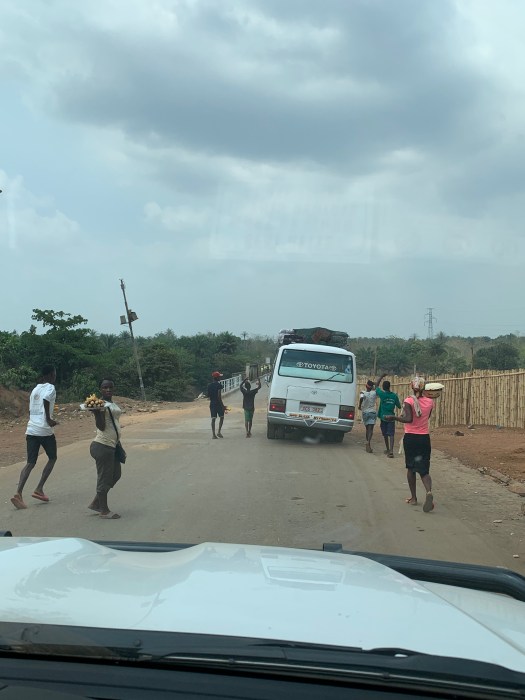
When the road narrowed for a single lane colonial era bridge, vendors flocked to the vehicles waiting to cross.
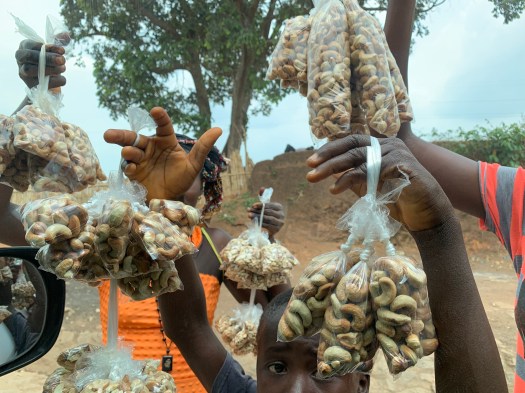
Local cashews and peanuts – very tasty!
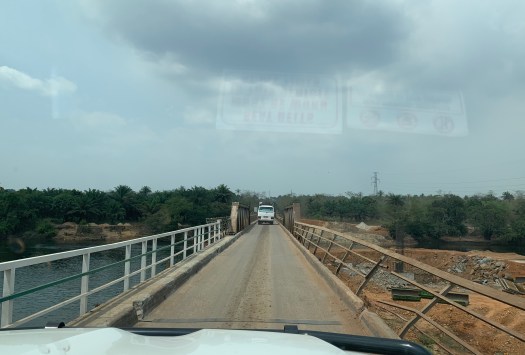
I thought this bridge was scary. I had no idea what lay ahead.
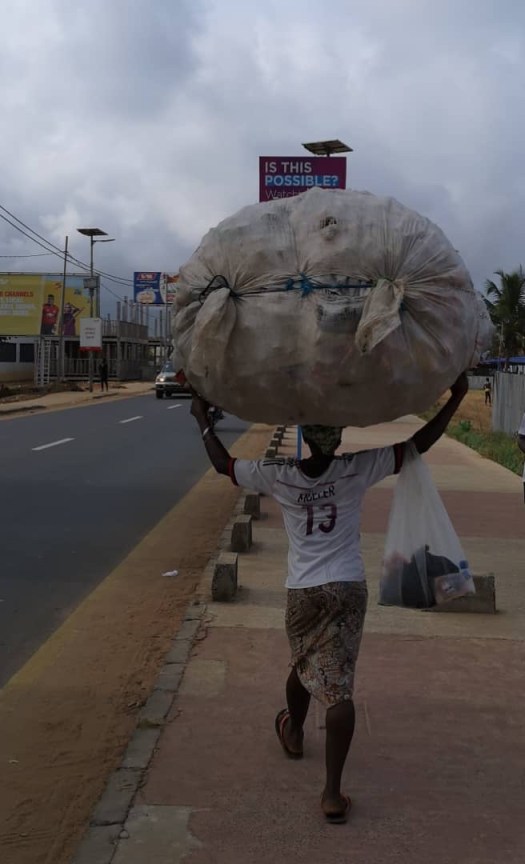
All along the way there were people selling mangoes on the side of the road. Mangos are just coming into season and it’s sort of like zucchinis. You can hardly give them away. People were also selling bags of home made charcoal. We saw one guy holding up some kind of dead animal – bush meat for sale. It was likely a cane rat.
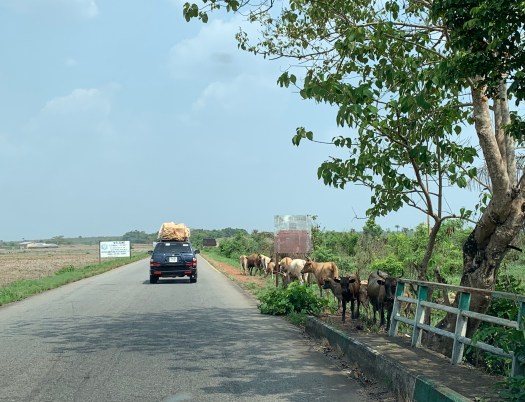
Horses were rare but cows, goats, sheep, chickens, and ducks had to be avoided on the road. The countryside was flat until we reached further north and stony hills emerged.
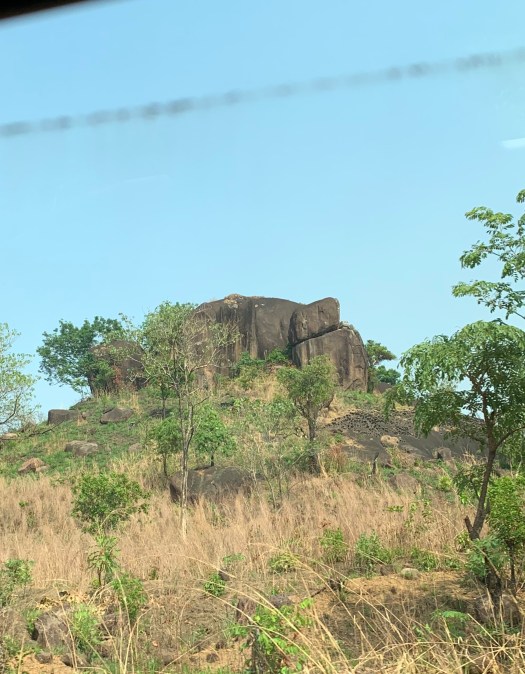
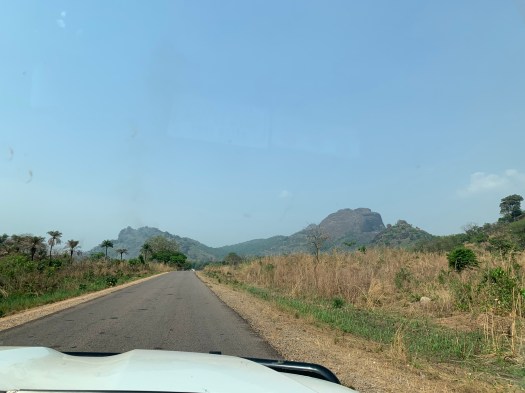
As we got further north, we encountered frequent road blocks. Some were police stopping vehicles with a rope across the road to collect a “tax.” I heard different stories about the tax. Some said the money was used for community projects, others were convinced much of the money went into police pockets. Other roadblocks were set up by school age boys to collect a “donation.” Our driver who is originally from the area said there was a story when he was growing up that a boy was given $200 by a tourist he stopped and it changed his life. When our driver tried setting up a home made road block, his mother caught him and gave him a hiding. He tried it again and a police officer caught him and gave him a hiding. He decided to pursue ways to make money that didn’t involve getting a hiding.
After 4 hours of driving, we arrived in Kabala, a lovely area, and went to our hotel. Unfortunately, we discovered that electricity would be limited to 7pm-1am and that water from the tap would also be limited. It turned out that electricity usually went off at at 11pm (the room would immediately become an airless sweaty place) and there would never be any water from any tap. Fortunately, I was prepared with many practical items gifted to me by thoughtful people prior to my departure. The flashlight and solar lantern, the quick dry towels, the permethrin coated sleep sack all came in handy. Once you’ve modified your expectations of the faucet and get a bucket of water, bathing and flushing are easily accomplished. Charging various electronics is harder with the limited hours of electricity but at least I had a backup battery.
More to come on Kabala and the other areas I visited.
 Jill’s Adventure in Sierra Leone